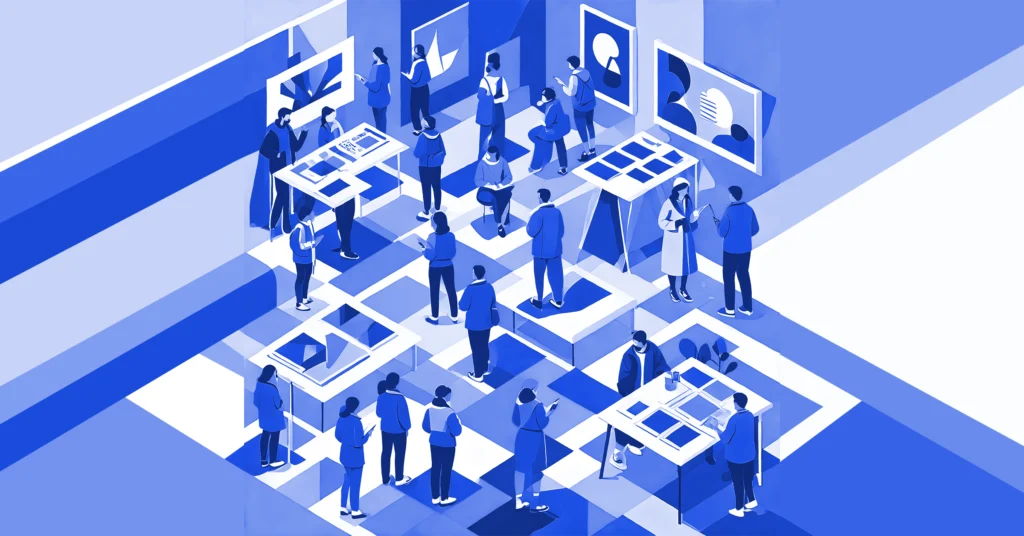
Sponsors rarely renew because their logo was displayed on a stage wall. They renew when conversations from the event turn into real sales opportunities. What stands out is how little many organizers do to support that process: the sponsorship package includes booth space, logo placement and two free tickets, while the question of what actually happens at the booth ends with a bowl for business cards or a piece of paper and a pen.
That creates a problem for sponsorship teams on the organizer side. The sponsor measures success in leads, while you measure it in package utilization. The two only line up when you give sponsors a way to capture their conversations properly.
This article looks at which data sponsors actually need at the booth, how to organize lead capture without adding extra work, and where AI can save time without confronting booth visitors with another form.
Why Business Cards Are No Longer Enough for Lead Capture
A business card contains a name, company and email address. For a sales team, that is the smallest possible dataset: it does not show what was discussed, how strong the interest was or which member of the sponsor team had the conversation.
There are three practical weaknesses as well.
1. The Data Entry Gap
After the event, cards are collected, bundled together and eventually entered into a CRM by someone. That task can easily sit untouched for a week. And the longer it takes, the colder the contact becomes.
2. Consent
Anyone using participant contact details for sales outreach needs a clear basis for doing so. A business card in a bowl does not prove what the person agreed to when they handed it over.
3. No Comparability
Ten sponsors, ten pieces of paper, ten different formats. As the organizer, you cannot reliably say how many conversations the event generated overall. That is where structured event lead capture becomes important.
What Sponsors Actually Need to Capture at the Booth
The dataset should be small but complete. As a minimum, five fields are enough:
- Contact: Name, company, role and email – ideally taken from the participant profile instead of being entered again.
- Interest: A choice of three or four levels, such as “Info is enough”, “Follow-up call” or “Proposal requested”.
- Topic: A keyword or product category.
- Note: One sentence in free text, including the option of a voice note.
- Timestamp and employee: Who spoke to the person and when?
The interest level is the key piece of information. It determines whether a contact gets a personal call the next day or ends up in a newsletter distribution list. Without it, everyone receives the same email – and recipients notice.
How to Organize Lead Capture Without Extra Work
The most common mistake is recommending a separate tool to the sponsor and then leaving it to chance whether anyone actually installs it. A better approach is to build the process into your ticketing flow.
Step 1: Badge with QR Code
At check-in, each participant receives a badge with a QR code. The code points to their profile in the participant list.
Step 2: Capture the Contact at the Booth
The sponsor’s booth staff scans the code with their own smartphone. Name, company and role appear immediately. Nobody has to type the contact details.
Step 3: Add Interest and Notes
Immediately after the conversation, the employee selects the interest level and adds a note. This takes around 20 to 30 seconds.
Step 4: Handle Consent
Consent is clarified in advance, for example through a checkbox during registration: “Sponsors may contact me about their offers.” Anyone who has not selected it receives a corresponding notice when scanned and is not exported.
Step 5: Make the Data Ready for Sales
After the event, the sponsor receives an export that can be imported directly into the CRM, including all five fields.
One calculation example based on assumptions, not measured data: a sponsor has 60 relevant conversations during a conference day. Without scanning, entering the data at around two minutes per card takes roughly two hours of additional work, plus follow-up questions when abbreviations are no longer readable. With scanning, this block is largely eliminated, allowing the sponsor to start following up the next day.
Where AI Helps – and Where It Should Stay Out
AI is most useful for tasks that happen after the conversation, not during it. Three use cases are particularly relevant:
- Summarizing notes: Voice notes or keywords can be turned into a sentence containing the topic and next step.
- Prioritizing leads: Interest level, role and company size can create a sequence for the next day’s follow-up.
- Preparing follow-ups: A draft email can be created for each interest level, which the sponsor reviews and adapts instead of sending automatically.
What is not useful is automatically rating booth visitors and displaying that rating openly. A booth conversation depends on personal interaction, and a scoring display on a phone can hurt the atmosphere.
Transparency also matters when processing personal data: What will the data be used for, and who can see it?
What You Gain as an Event Organizer
For sponsorship teams, this changes the sales conversation. Instead of offering “two free tickets and a logo”, you can promise a measurable result: every conversation is captured in the same format, and after the event you can report how many contacts each sponsor generated and how many of them requested a follow-up conversation.
That supports renewals. A sponsor that has 40 clean contacts in its CRM after the event does not need as much convincing to come back next year. And for new-business sales, the number of conversations captured in the previous year is a more tangible argument than total attendance.
Sponsor Checklist: 30 Minutes of Preparation
- Consent text: Define it in the registration flow and have it legally reviewed – 5 minutes of alignment with data protection.
- Interest levels: Define no more than four – 5 minutes.
- Badge QR codes: Test them during check-in – 10 minutes.
- Sponsor briefing: Explain on one page how to scan, classify and export – 5 minutes.
- Export format: Align it with the largest sponsor – 5 minutes.
Where eventpage.ai Fits In
The steps above can be handled in eventpage.ai without switching between tools. Participants register through the event page, including consent for sponsor contact. At check-in, they receive a badge with a code, and booth staff can capture contacts directly on their smartphone through the lead app, including interest level and notes.
After the event, an export is available for each sponsor. The AI functions support summaries and draft follow-ups, while approval remains with you and the sponsors. Hosting and data processing take place in Germany.
Invitation Management for Measurable Sponsor Leads
The quality of lead capture does not start at the sponsor booth. It starts with the invitation and registration process. When participant data is available in a structured format and consent for sponsor contact has already been clarified, contacts can be captured at the booth without asking visitors to enter their details again.
This makes Invitation Management an important part of the overall process: from invitation and registration to check-in and structured lead capture, the workflow stays connected. For sponsors, a booth becomes a measurable contact point – and for you as the organizer, the value of the sponsorship package becomes more concrete.
Planning your next sponsorship package?
Capture sponsor leads effortlessly with eventpage.ai and give every sponsor a clean, ready-to-use contact list.