19 percent of marketing teams use four to seven different event tech providers for a single event. At larger companies, the setup is often even more complex, with some organizations running six or more B2B event solutions in parallel and spending significant budgets on them.
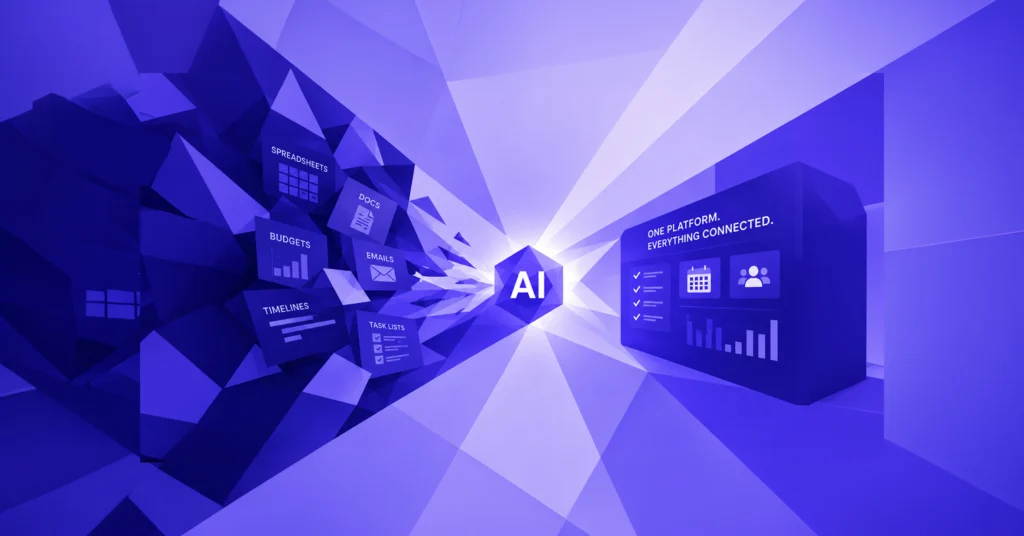
For conference organizers, that can mean one tool for ticketing, another for registration, another for the agenda, another for badges, one for sponsor tracking, one for networking, plus Excel spreadsheets holding everything together. Each system has its own login, data structure and often its own export process.
The problem rarely comes from individual tools being ineffective. In most cases, the tech stack has simply grown over time. Each tool solves a specific problem, but together they create duplicate data entry, inconsistent attendee lists and uncertainty about which system contains the latest information.
That is where event tech stack consolidation becomes relevant: the goal is to analyze the existing setup and create a shared data foundation for the most important event processes.
What Tool Sprawl Really Costs
Fragmented event planning tools create three recurring cost areas.
Duplicate data entry
Attendee changes, cancellations and booking changes often have to be updated manually across multiple systems. For a conference with 500 attendees and a 10 to 15 percent change rate during the final two weeks, this can quickly add several hours of administrative work each week.
More errors from inconsistent data
When registration, check-in and badge printing do not use the same data foundation, duplicates, misspelled names and missing attendees can appear at the venue even when payment has already been completed. On event day, these inconsistencies can directly affect waiting times and the overall flow.
Lost insights after the event
When attendance data, session participation and sponsor interactions sit in separate systems, it becomes difficult to build a complete picture of event performance. Instead of working with current information during the event, teams have to reconstruct the data from multiple exports afterward.
Consolidation Does Not Mean Forcing Everything Into One Tool
Event tech stack consolidation does not mean forcing every specialized function into one piece of software. The more practical goal is a shared data foundation that different functions can access.
Ticketing, registration, guest lists, check-in and badge printing should work from the same attendee data instead of creating multiple copies of the same information. Communication with attendees, speakers and sponsors should also remain consistent across the process.
This turns a collection of isolated event planning tools into a connected workflow. Individual functions can remain important, while the underlying data no longer has to be transferred manually between systems.
Where AI Actually Helps With Consolidation
AI event management is often associated with content generation. In practice, one of its more useful applications is supporting repetitive processes within a consolidated event tech stack.
Preparation
AI can support repetitive setup work, such as creating an initial event page from a rough concept, generating task lists for the organizing team or preparing speaker and sponsor briefings. According to the American Express GBT Meetings & Events 2025 Global Forecast, 50 percent of meeting planners already use AI for event planning and execution.
Communication
Automated, segmented communication helps teams send reminders, program updates and follow-ups to the right audiences. Guest Segments & Tags combined with automated notifications can reduce manual work that would otherwise be distributed across several systems.
Analytics
A centralized real-time dashboard can replace the process of manually combining numbers from different exports. During a conference, teams can see information such as session participation, check-ins and promoter link performance while the event is still running.
A Four-Step Consolidation Roadmap
- List every tool: Document all systems used for the next conference, including Excel spreadsheets that act as unofficial integrations.
- Review the data: For each tool, record which data is maintained there and where the same information exists elsewhere.
- Identify manual handoffs: Mark every point where information is manually transferred from one system to another.
- Evaluate consolidation: Check which of these transfers could disappear through a platform with a shared data foundation.
This approach makes it possible to consolidate an event tech stack step by step instead of replacing every existing system at once.
Where eventpage.ai Fits In
eventpage.ai brings together ticketing, registration, QR check-in, badge printing, Guest Segments & Tags, automated notifications, promoter links and a real-time dashboard on a shared data foundation. It also includes AI capabilities for event creation, task lists, briefings, and text and image generation.
For conference organizers, this means one attendee data foundation instead of multiple copies, a more consistent communication process and an analytics interface that stays current during the event.
According to customer analyses, teams save up to 50 working hours per event on average and achieve productivity gains of up to 60 percent by eliminating tasks that previously had to be handled between separate systems.
Invitation Management as Part of the Event Tech Stack
Invitation Management should not operate as an isolated process alongside registration and attendee management. A consolidated event tech stack creates the foundation for connecting invitations, attendee data, segments and automated notifications within one coherent workflow.
For conferences with different audiences, a shared data foundation helps prevent the same information from being maintained across multiple event planning tools. Invitation Management therefore becomes part of the complete attendee journey – from invitation and registration through check-in and post-event analysis.
Conclusion
A crowded folder of event tools is not automatically a sign of good preparation. Often, it shows how much complexity has accumulated inside the event tech stack. The first step toward consolidation is therefore not necessarily replacing everything, but taking an honest look at which systems use the same data, where duplicates occur and which manual handoffs could be eliminated through a shared platform.
With eventpage.ai, you can consolidate your event tech stack and manage key processes on a shared data foundation.
Want to consolidate your event tech stack? With eventpage.ai, you can bring your core event processes together on a shared data foundation.