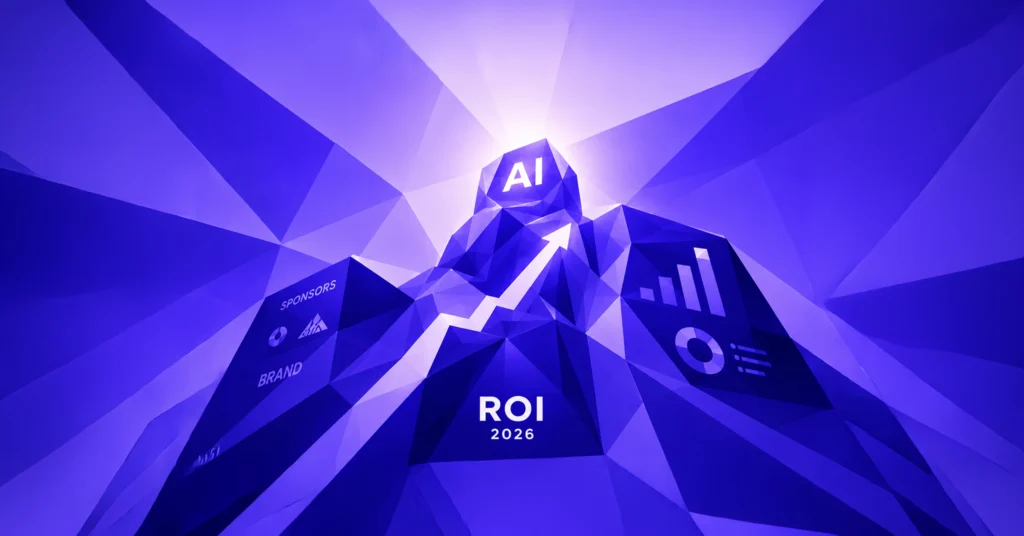
Today, selling sponsorship no longer means selling visibility alone. Sponsors expect clear proof of the business impact their investment has created. This is where many event organizers still struggle: they deliver logo exposure, attendee numbers, and event photos — but no reliable ROI data.
In 2026, sponsor expectations have changed significantly. Sponsors compare events like any other marketing channel and want to know how many qualified contacts, conversations, and business opportunities were actually generated. With modern AI-powered event platforms, event sponsorship ROI can finally be measured in a transparent, scalable, and actionable way.
In this article, you will learn which KPIs matter most, how to measure event sponsorship ROI, and how artificial intelligence improves sponsor reporting.
Why Event Sponsorship ROI Matters More Than Ever in 2026
Sponsorship is increasingly treated as a business investment — not as a branding activity without clear performance metrics. Marketing leaders, sponsorship managers, and CFOs expect concrete data on the impact of each partnership.
At the same time, tracking technologies and data integrations have become much more accessible. What used to require complex enterprise systems can now be analyzed automatically through modern event management platforms.
For event organizers, this means one thing: sponsor reporting often determines whether a sponsor renews, increases the budget, or chooses another event.
The 6 Most Important KPIs for Sponsor Reporting
1. Qualified Leads
The most important metric is the number of relevant contacts generated. The key is to distinguish between raw contacts and truly qualified conversations.
- Raw leads collected
- Qualified conversations
- Meeting requests
- Demo requests
2. Cost per Lead
Cost per lead shows how efficiently the sponsorship budget was used. It is calculated by dividing the sponsorship investment by the number of qualified leads generated.
3. Audience Match Score
A sponsor does not benefit from many contacts. A sponsor benefits from the right contacts. The Audience Match Score shows how closely event attendees match the sponsor’s ideal customer profile.
4. Engagement Depth
How deeply did visitors interact with the sponsor brand?
- Booth dwell time
- Product demos
- Workshop participation
- Downloads and content interactions
5. Qualified Brand Exposure
Instead of reporting generic impressions, organizers should measure how many relevant attendees had multiple meaningful touchpoints with the sponsor brand.
6. Pipeline Influence
The strongest metric for many sponsors is long-term sales impact. How many event leads are still active in the CRM 30, 60, or 90 days after the event?
How AI Makes Event Sponsorship Measurable
The biggest challenge is rarely collecting data. The real challenge is connecting and interpreting it. Sponsorship data is usually spread across multiple systems:
- Ticketing systems
- Check-in tools
- Badge scanners
- CRM platforms
- Survey tools
- Event apps
AI helps consolidate this information and turn it into clear, actionable sponsor insights.
AI Use Case 1: Real-Time ICP Matching
Modern AI models can automatically compare attendee profiles with a sponsor’s target audience criteria. This makes it clear which share of sponsor interactions was truly relevant.
Example:
327 out of 612 booth visitors matched the sponsor’s ideal customer profile — match rate: 53.4%.
AI Use Case 2: Automated Conversation Qualification
Sales teams can capture short audio notes after each booth conversation. AI transcribes the notes, identifies buying signals, and categorizes leads by priority.
AI Use Case 3: Automated Sponsor Reporting
AI can generate reports with KPI analysis, year-over-year comparisons, pipeline forecasts, and practical recommendations. This significantly reduces manual reporting effort and speeds up sponsor communication.
A 5-Step Workflow for Event Sponsorship ROI Reports
- Define the ICP: Set target audiences and success metrics before the event and include them in the sponsorship agreement.
- Standardize lead capture: Make sure data is collected consistently during the event.
- Centralize event data: Connect ticketing, CRM, and engagement data in one platform.
- Run AI-powered analysis: Automatically calculate match scores, engagement metrics, and pipeline forecasts.
- Present results personally: Discuss the report with the sponsor in a dedicated review call.
Common Mistakes in Event Sponsorship Measurement
- Measuring ROI only through reach or impressions.
- Sending sponsor reports weeks after the event.
- Using the same reporting template for every sponsor.
- Defining KPIs only after the event.
- Failing to connect event data with CRM data.
The most successful event organizers define success metrics before the agreement is signed and create transparency across the full event lifecycle.
How eventpage.ai Automates Event Sponsorship ROI
eventpage.ai brings event data, lead capture, and sponsor reporting together in one AI-native event management platform.
With eventpage.ai, organizers can:
- Capture leads directly on site
- Calculate ICP matches in real time
- Connect CRM systems such as HubSpot, Salesforce, or Pipedrive
- Generate automated sponsor reports
- Prove sponsorship performance with data
The result: less tool chaos, faster reporting, and stronger sponsor renewal conversations.
FAQ: Event Sponsorship ROI and Sponsor Reporting
How do you measure event sponsorship ROI?
Event sponsorship ROI can be measured by combining lead data, engagement metrics, audience match scores, and CRM insights. This creates a clear picture of the actual business value generated by a sponsorship.
Which KPI matters most for sponsors?
For many B2B sponsors, qualified leads, cost per lead, and pipeline influence are the most important performance indicators.
How does AI improve sponsor reporting?
AI automates data analysis, lead qualification, ICP matching, and report generation. This makes sponsor insights available faster and with greater consistency.
When should a sponsor report be delivered?
Initial insights should be available within 48 hours after the event. The full sponsor report should ideally be delivered within the first seven days.
Conclusion
Event sponsorship ROI is no longer optional in 2026. It is a key factor for sponsor renewals, budget growth, and long-term partnerships. Event organizers who can measure sponsorship performance build trust and create a stronger foundation for future revenue.
When event data, lead capture, and reporting work together intelligently, sponsorship becomes a measurable business investment — not a vague marketing activity.
Want to measure sponsorship ROI, lead quality, and sponsor performance automatically? Book a personal demo and see how eventpage.ai helps event organizers prove sponsorship success with data.