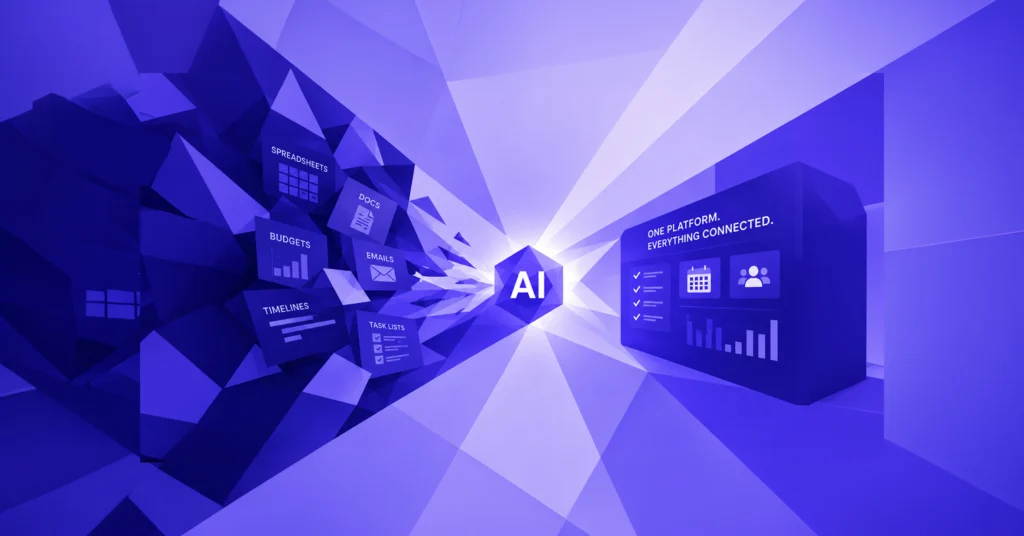
You’re planning an event for 200 people. On your screen, 14 tabs are open: one tool for tickets, one for invitations, one for registrations, one for the guest list, one for the agenda, one for emails, one for badges and somewhere there is still an Excel file that nobody really wanted to touch anymore.
Sound familiar?
Then the problem is probably not your organization. It is your tool stack. Many event teams today work with too many systems at once. Each tool solves a small problem, but together they create a big one: data has to be copied, lists need to be reconciled, emails are manually adjusted and changes have to be updated in multiple places.
This is exactly where modern AI event planning software comes in. It does not replace your experience, creativity or understanding of your guests. But it takes over the tasks that slow you down in daily operations: recurring copy, manual data maintenance, setup processes, reminders, guest communication and reporting.
In this guide, you will learn why too many event tools make planning unnecessarily complex, what AI can realistically take over today and how to simplify your event stack step by step.
Why too many event tools slow down your planning
At first glance, a large tool stack can look professional. There is a specialized solution for every task: ticketing, email marketing, registration forms, landing pages, project management, team communication, design and analytics.
That sounds reasonable. Until you realize that these tools do not work together properly.
A typical workflow often looks like this:
- A person registers through a form.
- The data is transferred to a guest list.
- A confirmation email is sent.
- The person is added to a list in an email tool.
- A badge is created.
- Calendar information is added.
- If anything changes, several systems need to be updated.
With ten guests, this is still manageable. With 200 guests, it quickly turns into operational work that costs hours or even days.
The hidden costs of tool chaos
Tool chaos does not just cost money. It costs focus, reliability and quality.
First: You lose time through manual data maintenance.
Every registration, every change and every cancellation has to be updated somewhere. The more systems are involved, the greater the effort.
Second: Errors happen faster.
A misspelled name, a duplicate registration or a forgotten email may seem small. But for guests, these details can quickly feel unprofessional.
Third: Your team loses visibility.
When information is spread across multiple tools, at some point nobody knows exactly which list is up to date. This leads to questions, delays and unnecessary stress.
Fourth: You pay twice for overlapping features.
Many event tools overlap. If landing page, email, registration, check-in and analytics are billed separately, monthly costs can rise quickly.
What AI event planning software can actually do today
AI in event planning is no longer a future topic. Used in the right way, it already helps you move faster from idea to finished event page.
But here is the important part: AI should not simply become another tool in your stack. The biggest benefit comes when AI is built directly into your event management software.
That way, it works where your data, content and processes already live.
Automatic event pages instead of blank pages
One of the biggest hurdles in event planning is often getting started. You roughly know what you are planning, but the event page is still empty. Title, description, agenda, call to action, form copy and SEO content still need to be written.
With an AI-powered event platform, you can describe your event in just a few sentences, for example:
B2B marketing meetup in Berlin, June 22, 80 seats, networking focus.
The AI turns this into a first event page with structure, description, agenda suggestion and registration area. You do not have to start from scratch. You can immediately edit, refine and publish.
This saves time especially when you regularly plan similar events: workshops, webinars, networking evenings, roadshows, community events or internal company events.
Classic event stack vs. AI-powered platform
| Area | Classic stack | AI-powered event platform |
|---|---|---|
| Event page | WordPress, Webflow or landing page tool | Integrated |
| Registration | Typeform, Google Forms or form plugin | Integrated |
| Ticketing | External ticketing tool | Integrated |
| Email communication | Mailchimp, Brevo or manual emails | Integrated and AI-supported |
| Agenda | Notion, spreadsheets or session tools | Integrated |
| Guest list | Excel or Google Sheets | Integrated |
| Badges | Design tool or separate badge tool | Integrated |
| Check-in | Manual list or check-in app | Integrated |
| Analytics | GA4, Excel or separate reports | Integrated |
Conclusion: The best event tool is often fewer tools
More tools do not automatically mean better event planning. Often, they mean more interfaces, more manual work and more sources of error.
Modern AI event planning software helps you reduce exactly that. It bundles central tasks, automates recurring processes and gives you a clear data foundation for your event.
If you currently work with many separate event tools, now is a good time to make your event planning more central, simple and efficient.
With eventpage.ai, you plan your next event more centrally, faster and with greater clarity — from event page to follow-up.
Plan your next event more centrally and faster
If you are still working with multiple tools, spreadsheets and manual workarounds, now is the right time to simplify your event planning.
With eventpage.ai, you bring event page, registration, guest management, communication and reporting together in one central workflow.